
Recently one of my favorite fellow LARPers asked me how I gather the elements of my garb kit, especially where layers are involved. I didn’t really have an answer for them in the moment, but after thinking about how I’ve put together some of my favorite garb sets, I started to realize that I do have some basic principles and elements that I use. This guide may not be for everyone, but it works for me! If you like my style, try it out and see what it can do for you.
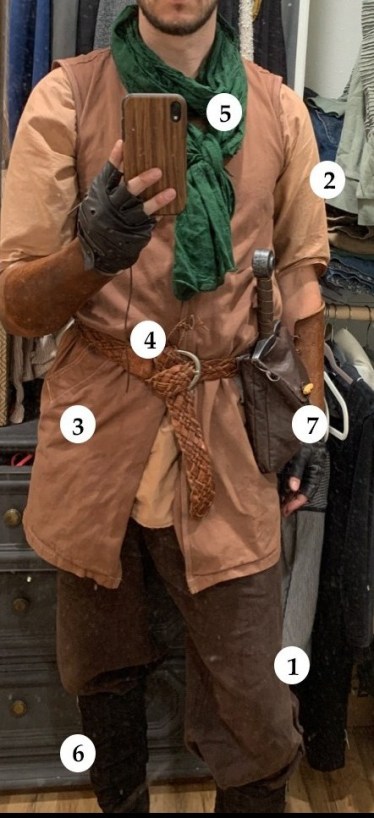
1. Pants
For obvious reasons, these are simply a must. I recommend dark brown pants, but black, khaki and other subdued colors work well depending on the rest of your outfit’s color palette. Find a drawstring lounge pant in the most heavy-duty but breathable fabric you can find — and as always, save money by checking the thrift store first!
2. Neutral Base Layer
This will be the canvas on which you paint the rest of your outfit, so keep it simple and unobtrusive. I recommend white, natural/beige, light tan or khaki, grey, or simply a lighter shade of your primary or signature colors (more in a sec). It should be the most form fitting of your upper pieces, and should also have the longest sleeve.
3. Primary Color Outer Layer
Next comes your most visible article of clothing. It can be a tunic with a shorter sleeve, a tabard or surcoat, or a vest or jerkin. This should fit comfortably over your base layer without bunching or squeezing everything underneath. Make it a bolder color than your base layer, but not flashy. We’re still building to the climax of your kit.
4. Belt
Up to this point, we could be describing pajamas. The one essential item that makes it indisputably a LARP garb kit is a period-looking leather belt. You can almost always find these at your local thrift store – it should be worn from use and if possible, a good bit longer than your waist actually requires. I find that a braided or woven belt adds an extra bit of visually interesting detail that helps put the whole kit over the top.
5. Signature Color Flair
This is where we go from basic to a serious, well-put-together kit. This item will be the color people associate with you, and the centerpiece of your garb kit. It should be the boldest and flashiest of the colors in your kit, but as a balance, it should also be a relatively small part. Think of a hood or mantle, a cape or cloak that stays mostly back, or a long loose vest worn open. Mine is usually a thin green scarf that gathers loosely around my neck and hangs down my chest.
6. Boots
There’s a lot of wiggle room here, because your footwear won’t generally be the most visible part of your kit. But if you feel like it and have the opportunity, a pair of boots in brown or black will go a long way to help your kit look fly. Look for a used pair of military boots for a rugged utility look with a lot of function, or a pair of fashion suede boots in the women’s section of your thrift store for a more period look — just be aware that finding larger sizes might take a little luck and patience. And most importantly, make sure if you’re fighting in them, they have a sturdy, non-slippery flat sole!
7. Other Accessories
Add more stuff! Gloves, belt pouches, jewelry, sashes around the waist, bracers…go nuts! A few tips though: try to keep any leather accents in a similar color as your belt and boots, and don’t upstage the signature color flair piece.
That’s it! Now that you know the basic elements and a structure for how to put them together, try experimenting. What colors work together for your character? How many different textures and patterns can you incorporate without looking like a clown? Can you add or remove layers as the weather dictates, or change the order for a new look? Go nuts!
 The Budget LARPer